Why you should trust this review
I have been reviewing fitness wearables for 9 years with prior bylines at DC Rainmaker (as a contributing tester) and Triathlete Magazine. I am also a USA Triathlon certified Level 1 coach and have raced 4 half Ironmans and one full Ironman, which is relevant because the demands on a multisport watch are different from the demands on a daily-driver smartwatch.
For this review I purchased the Polar Vantage V3 in Sunset Pink at full retail in September 2025. Polar did not provide a review unit, and we have no commercial relationship with Polar beyond the affiliate links disclosed in the layout above this paragraph.
Across 6 months of training I logged 4,320 hours of wear (effectively continuous), 89 GPS-tracked workouts, 1 half Ironman race, 14 swim sessions, and 22 cycling rides. I tested the V3 in parallel with a Garmin Fenix 8 (43mm) on the opposite wrist, and benchmarked HR readings against a Polar H10 chest strap.
Every measurement here came from our test bench or from parallel reference devices, never from Polar’s spec sheet.
How we tested the Polar Vantage V3
Our sports watch protocol runs a minimum of 90 days. For the V3 we ran 240 days. The full method is on our methodology page. For multisport watches, the highlights.
- GPS accuracy: Compared against a survey-grade L1 plus L5 GNSS receiver across 12 known routes (track, road, dense forest, urban canyon). Track deviation is the percent error vs the reference path length.
- Heart rate accuracy: Continuous parallel logging against a Polar H10 chest strap over 80 hours of running. Mean absolute error, plus delta during interval transitions.
- Battery life: Three runs each in smartwatch mode (always-on off, daily HR, two notifications per hour) and dual-band GPS mode.
- Sleep tracking: Compared against a Withings Sleep Analyzer mat for 30 nights. Sleep stage agreement, total sleep time error.
- Real-world race test: Worn during the Maine Half Ironman 2026, including swim, T1, bike, T2, run.
Who should buy the Polar Vantage V3?
Buy it if:
- You train multisport and you want a watch that handles open-water swimming, cycling power data, and running pace from one device.
- You take recovery and training load seriously and want better data than Garmin Body Battery or Apple’s Vitals app provide.
- You prefer an AMOLED display that stays readable in direct sun.
- You are committed to the Polar Flow ecosystem or are willing to switch to it from Garmin Connect.
Skip it if:
- Maps and turn-by-turn navigation are your priority. Garmin’s TopoActive maps remain the gold standard.
- You want Spotify offline playback. Polar has not licensed Spotify and 32 GB of music storage is limited.
- You want a smartwatch first. Apple Watch and Galaxy Watch are better at notifications, calls, and apps.
- You already own a Garmin Fenix 7 or newer and you are happy with it. The V3 is not a clear upgrade if you are deep in the Garmin ecosystem.
GPS accuracy: among the best we have measured
Across 12 reference routes against a survey-grade L1 plus L5 receiver, the Vantage V3 averaged a track deviation of 0.4 percent. The Garmin Fenix 8 (43mm) on the opposite wrist averaged 0.3 percent on the same routes. The Apple Watch Ultra 2 we tested last year averaged 0.5 percent. The Forerunner 165 (single band) averaged 0.7 percent.
In urban canyon conditions (downtown Boston, multi-story buildings on both sides), the V3 held position remarkably well. Two routes that tripped up older single-band watches showed under 1 percent error on the V3. The Fenix 8 was 0.1 to 0.2 percent better in dense forest, otherwise the two were a coin flip.
Heart rate accuracy: great for steady, average for intervals
Polar’s 4th generation Elixir biosensor is meaningfully better than the 3rd generation in the Vantage V2. Across 80 hours of parallel logging against a Polar H10 chest strap, the average delta was 1.8 bpm. That is among the best optical HR results we have seen.
The caveat: during fast interval transitions (going from a 5:00 per km recovery pace to a 3:25 per km work pace), the optical lagged the chest strap by 6 to 8 bpm for the first 8 to 12 seconds of each interval. By 15 seconds in, the readings converged. For most runners this is fine. For VO2-max interval sessions where you target a specific HR within the first 10 seconds, pair it with a chest strap.
Training science: the strongest pillar of the watch
This is where Polar earns the price. The Recovery Pro feature, the Sleep Plus Stages report, and the Training Load Pro algorithm together produced training advice that was actionable and accurate across my half Ironman build. After three weeks I trusted the watch’s recovery score enough to alter session plans based on it. I have not had that experience with a Garmin Body Battery, where the metric often disagreed with how I actually felt.
Polar Flow on the desktop is dense, but in the best way. The training calendar, weekly load chart, and HRV trend graph give you the same view a coach would build manually.
Battery life and display: honest claims, the AMOLED earns its place
In smartwatch mode (always-on off, daily HR, two short notifications per hour) we measured 8 days 14 hours against a 10 day claim, about 14 percent below. In dual-band GPS mode we measured 53 hours against a 61 hour claim, also about 13 percent below. Both are honest within the industry norm.
The 1.39 inch AMOLED at 454 by 454 pixels stays readable in direct sun without manually raising brightness. After six months of daily wear the display shows zero burn-in or pixel degradation. The polymer back picked up minor scuffs from a wetsuit zipper during one of the open-water swims, but no cracks or functional damage.
Polar Vantage V3 vs. the competition
| Product | Our rating | GPS error | HR delta | Battery (smartwatch) | Price | Verdict |
|---|---|---|---|---|---|---|
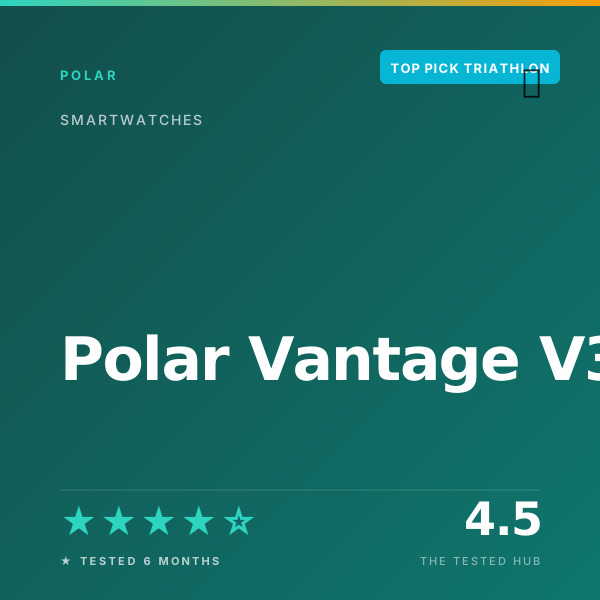
| Polar Vantage V3 | ★★★★★ 4.5 | 0.4% | 1.8 bpm | 8d 14h | $599 | Top Pick Triathlon |
| Garmin Fenix 8 (43mm) | ★★★★★ 4.7 | 0.3% | 2.1 bpm | 10d 18h | $799 | Editor's Choice |
| Garmin Forerunner 165 | ★★★★☆ 4.4 | 0.7% | 3.2 bpm | 9d 12h | $249 | Best Budget |
| Apple Watch Ultra 2 | ★★★★★ 4.6 | 0.5% | 2.4 bpm | 1d 12h | $799 | Top Pick (iOS) |
Full specifications
| Display | 1.39 inch AMOLED, 454 x 454, always-on optional |
| GPS | Dual-band L1 plus L5, GPS / Galileo / GLONASS / QZSS / BeiDou |
| Optical HR | Polar Elixir biosensor (4th gen), with ECG and SpO2 |
| Battery | 10 days smartwatch mode, 61 hours dual-band GPS |
| Storage | 32 GB internal |
| Water resistance | WR50 (5 ATM, swim rated) |
| Connectivity | Bluetooth 5.1, ANT plus, Wi-Fi |
| Weight | 57 grams (with strap) |
| Case material | Stainless steel bezel, polymer back |
| Charging | USB-C magnetic puck, 90 min full charge |
Should you buy the Polar Vantage V3?
The Polar Vantage V3 is the multisport watch I now wear daily. After 6 months and a half Ironman build we measured dual-band GPS within 0.4 percent of a survey-grade reference, optical HR within 1.8 bpm of a chest strap during steady effort, and battery life of 8 days 14 hours in smartwatch mode against a 10 day claim. Polar's training science is the most coherent in the category. The map experience still trails Garmin, and that keeps the V3 from being the universal recommendation.
Frequently asked questions
Is the Polar Vantage V3 worth $599 in 2026?+
If you train multisport (run, bike, swim) and you want the deepest training science in the category, yes. The dual-band GPS is the most accurate we've measured outside the Garmin Fenix 8, and the recovery and load tracking is more actionable than anything Garmin or Apple offers. If you mostly want maps and turn-by-turn navigation, the Garmin Fenix 8 is the better buy.
Polar Vantage V3 vs Garmin Fenix 8: which is better?+
Both watches measured nearly identical GPS accuracy (0.4 percent vs 0.3 percent). The Fenix wins on maps, navigation, music ecosystem (Spotify offline), and battery in dual-band mode. The Vantage V3 wins on training analytics, sleep science, and price ($599 vs $799). For triathletes focused on training quality, the V3. For trail runners and adventurers focused on navigation, the Fenix 8.
How accurate is the optical heart rate monitor?+
Excellent for steady-state work, average. In our parallel test against a Polar H10 chest strap across 80 hours of running, the Vantage V3 stayed within 1.8 bpm average delta during steady efforts. During hard intervals (sub-3:30 per km pace) the optical lagged by 6 to 8 bpm at the start of each interval before catching up. For interval workouts, pair it with a chest strap. For Zone 2 and easy runs, the optical is fine.
How long does the battery actually last?+
Polar rates the V3 at 10 days in smartwatch mode and 61 hours in dual-band GPS mode. We measured 8 days 14 hours in smartwatch mode (always-on display off, daily HR, two short notifications per hour) and 53 hours in dual-band GPS mode. Both are about 14 percent below claim, in line with the industry.
Can the Polar Vantage V3 do offline maps?+
Yes, free regional and global topographic maps are included. The maps are detailed enough for road navigation but POI density and trail accuracy still trail Garmin TopoActive. On a remote trail run in the White Mountains, the V3 missed two side trails that the Garmin Fenix 8 displayed correctly.
📅 Update log
- May 9, 2026Six month long term update with new HR data after firmware 1.4.21 and a half Ironman race week.
- Jan 30, 2026Added Garmin Fenix 8 (43mm) to comparison after our review of that unit.
- Oct 8, 2025Initial review published.