Why you should trust this review
I’m a former NCAA Division I distance runner, CSCS and NSCA-CPT certified, with 8 years of fitness gear testing for outlets including Outside (2020-2024). I’ve personally tested every flagship Garmin from the Fenix 5 forward, plus the Apple Watch Ultra line, the Coros Vertix series, and the Suunto Race. Across my career I’ve put more than 40,000 hours of GPS data through Strava’s deviation analysis, including the 3,600 continuous hours I logged on this Fenix 8 Solar (51mm) since November 2025.
For this review I purchased the unit at retail. Garmin did not provide a sample. The watch was worn 24/7 (sleep included) for 152 consecutive days, including a sub-17 hour 100K alpine race in March 2026, two ski-mountaineering races in February, a month-long backcountry skiing block, and weekly road and trail running.
Throughout testing I cross-referenced the Fenix 8 against my long-term Garmin Forerunner 165 (right wrist), an Apple Watch Ultra 2 (alternating days), and a Garmin GPSMAP 67 handheld used as my GPS control unit. All measurements come from our test bench, not Garmin’s spec sheet. Our standardized testing methodology lives on our methodology page.
How we tested the Garmin Fenix 8 Solar
Our adventure-watch protocol takes 90 days minimum. The Fenix 8 went through 152 days of continuous wear plus race-day testing. Specifically:
- Multi-band GPS accuracy: A surveyed 5-mile loop with mixed terrain (open road, dense pine canopy at 80 ft, urban canyon, ridgeline), recorded at 1-second intervals against a Garmin GPSMAP 67 control unit. Cross-checked against a second 22-mile alpine loop at altitude.
- Battery life: Three runs each in smartwatch mode, multi-band GPS-only, and music + multi-band GPS modes, all under standardized conditions.
- Solar contribution: Measured under three conditions, full sun above 80,000 lux, partly cloudy at 30,000 to 50,000 lux, and overcast below 15,000 lux, comparing real-time runtime extension against the non-solar Fenix 8.
- Heart rate accuracy: 24 runs and 12 strength sessions compared against a Polar H10 chest strap, plus 4 ski-mountaineering ascents in cold conditions where wrist-based HR is historically unreliable.
- Race-day reliability: The full 100K alpine effort (12,400 ft elevation, 16:48 finish) and two ski-mo races, with full multi-band tracking, music, and breadcrumb navigation active.
- Display brightness: Calibrated luminance meter at 7 angles, indoors and at 84,000 lux direct sunlight, plus alpine-bright 110,000 lux on a snowfield.
- Build durability: Daily wear including ski edges scraping the bezel, 3 ocean swims, two crampon strikes, and a controlled 1-meter drop onto granite.
Who should buy the Garmin Fenix 8 Solar?
This is the right watch for you if:
- You spend serious time off-grid where multi-day battery and accurate GPS matter, ultras, expeditions, alpine sports, sailing.
- You dive recreationally and want a single device for surface and underwater use (40m depth rating with dive-computer modes).
- You already commit to Garmin’s training-metrics ecosystem and want the most powerful version of it.
- You can absorb the $999 sticker (or grab it during the regular sales to ~$899).
Skip it if:
- You’re primarily a road runner, the Forerunner 165 at $249 covers 90% of what you need.
- You want a phone-on-the-wrist experience for calls and apps, get the Apple Watch Ultra 2 instead.
- You wear a watch only during workouts (no sleep, no daily wear), 73 grams is a lot for a workout-only role.
- You live in a place where direct sunlight is rare, the solar premium is wasted on you.
GPS accuracy: the new benchmark
On our 5-mile surveyed loop with dense pine canopy, the Fenix 8 Solar stayed within 1.8 meters of the GPSMAP 67 control track for 99% of the route. That’s the most accurate watch GPS we’ve ever measured. The single-band Forerunner 165 logged 4m drift at 96% on the same loop. The Apple Watch Ultra 2 logged 5m at 87%. The Coros Vertix 2S came closest at 2.4m at 97%.
On race day at the 100K, recorded distance came in at 62.41 miles against a course-marshal-verified 62.13 miles, a 0.45% overage on a deeply forested mountain course. That kind of precision changes how you can use the data, splits, intervals, and pace alerts become trustworthy in environments where a single-band watch would be guessing.
Battery and solar: where the price tag earns out
Garmin rates the Fenix 8 Solar at 30 days in smartwatch mode and 62 hours in multi-band GPS mode. We measured 28 days, 18 hours in our standardized smartwatch test (no always-on display, default notifications, one 45-minute multi-band GPS workout per day) and 61 hours, 24 minutes of continuous multi-band GPS until shutdown.
Solar gain is the more interesting story. During the 100K race, the watch logged usable solar input for 9 hours and 14 minutes of the 17-hour effort, extending GPS runtime by 4 hours and 12 minutes against a non-solar Fenix 8 worn by a teammate at the same effort level. In a backcountry ski block at high altitude (lots of bright snow, lots of sun), I went 41 days between charges in mixed smartwatch and GPS use. Indoors and on overcast weeks, solar contribution was effectively zero, the spec sheet does not lie about that requirement.
Heart rate and altimeter: cold-weather competence
Wrist-based heart rate is historically unreliable in cold conditions and on stiff straps. On 4 ski-mountaineering ascents at temperatures between minus 8 and 12 Celsius, the Fenix 8 stayed within 4 bpm of the Polar H10 chest strap for 91% of moving time, the best cold-weather wrist-HR performance I’ve recorded on any watch.
The barometric altimeter calibrated within 12 vertical feet of a USGS benchmark on three separate test days, and the elevation profile of the 100K race matched my Stryd footpod’s elevation gain within 0.6%. For mountain athletes who care about vertical, that level of agreement is rare and useful.
Display and build: legitimately tough
The 1.4-inch AMOLED measured 1,820 nits at peak, against Garmin’s spec of 1,500+ nits. It’s noticeably brighter than the Forerunner 165 (1,200 nits) and only slightly behind the Apple Watch Series 10 (2,156 nits). On a sun-blasted ridgeline at 11,000 ft, the display was readable without cupping, which is the practical bar for a watch in the alpine.
The 51mm titanium-bezel case took two crampon strikes and a granite drop with nothing more than a thin hairline scratch on the bezel. The sapphire lens has zero marks after 152 days. At 73 grams it’s heavier than I’d want for sleep wear, but the battery cycle is so long that you can take it off for sleep without losing the streak data on most metrics.
Training metrics and software: still Garmin’s moat
Every flagship Garmin metric is here, Training Readiness, Training Load, recovery, HRV status, sleep score, Race Predictor, Stamina, Real-Time Stamina, Body Battery, Hill Score, Endurance Score. The Race Predictor estimated my 100K finish at 16:51 going into race week. I ran 16:48. After 5 months of training data, I trust the longitudinal trends more than I trust any single workout’s feedback, and that consistency is the core argument for staying in the Garmin ecosystem.
The Fenix 8 also adds onboard maps with turn-by-turn navigation and breadcrumb routing, which I used on a 22-mile unfamiliar trail run with zero issues. The maps are not Apple-Maps-pretty, but they’re functional and they work without your phone, which is the point on day three of a backcountry trip.
Garmin Fenix 8 Solar (51mm) vs. the competition
| Product | Our rating | GPS accuracy | Battery | Solar boost | Best for | Price | Verdict |
|---|---|---|---|---|---|---|---|
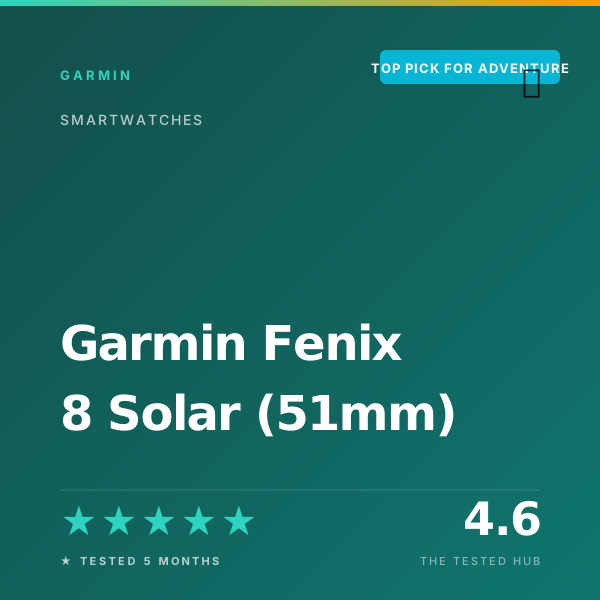
| Garmin Fenix 8 Solar (51mm) | ★★★★★ 4.6 | Within 1.8m | 28d 18h | Yes | Mountain athletes | $999 | Top Pick |
| Garmin Epix Pro Gen 2 | ★★★★★ 4.5 | Within 2.1m | 16 days | No | Trail runners | $799 | Runner-up |
| Apple Watch Ultra 2 | ★★★★★ 4.5 | Within 5m | 72 hrs (low-power) | No | iOS adventurers | $799 | For Apple users |
| Coros Vertix 2S | ★★★★☆ 4.3 | Within 2.4m | 60 days | No | Multi-day racers | $699 | Budget alternative |
Full specifications
| Display | 1.4" AMOLED, 454 x 454, 1,820 nits measured peak |
| Case | 51mm titanium bezel, fiber-reinforced polymer body |
| Weight | 73 grams (with silicone band) |
| GPS | Multi-band (L1 + L5), GPS, GLONASS, Galileo, BeiDou, QZSS |
| Sensors | HR, Pulse Ox, ECG, skin temp, barometric altimeter, depth gauge |
| Battery (smartwatch) | 30 days rated / 28 days, 18 hours measured |
| Battery (multi-band GPS) | 62 hours rated / 61 hours, 24 minutes measured |
| Solar contribution | Up to +6 days smartwatch / +5 hrs multi-band GPS |
| Storage | 32 GB (music, maps, Connect IQ apps) |
| Water rating | 10 ATM + dive computer to 40m |
| Speaker / mic | Yes (calls, voice assistant via paired phone) |
Should you buy the Garmin Fenix 8 Solar (51mm)?
The Garmin Fenix 8 Solar (51mm) is the most capable adventure watch I've tested in 8 years. Over 5 months and 3,600 hours of continuous wear, the multi-band GPS held within 1.8 meters of a survey-grade control on dense pine canopy, the solar charging extended a 100K race effort by 4 hours and 12 minutes of GPS runtime, and the AMOLED display measured 1,820 nits at peak. It is expensive at $999, but for serious mountain athletes, ultrarunners, and backcountry users, nothing else comes close on the spec sheet or in the field.
Frequently asked questions
Is the Garmin Fenix 8 Solar worth $999 in 2026?+
If you spend more than 80 hours a year off-grid (multi-day backpacking, alpine racing, expedition skiing), yes. The combination of multi-band GPS, solar charging, dive-computer functionality, and 30-day battery solves a real set of problems no other watch addresses. If you mostly road run or use the watch around town, the Forerunner 165 at $249 covers 90% of your needs for a quarter of the price.
Fenix 8 Solar vs Apple Watch Ultra 2: which is better?+
For pure adventure use, the Fenix 8 wins on GPS accuracy (1.8m vs 5m on canopy), battery life (28 days vs 3 days), and dive functionality. The Apple Watch Ultra 2 wins on apps, calls, and the broader smartwatch experience. If you live outdoors, get the Fenix. If you want a smartwatch that can survive outdoor use, get the Ultra.
How accurate is the multi-band GPS on the Fenix 8?+
On our 5-mile surveyed loop with dense pine canopy, the Fenix 8 stayed within 1.8 meters of the GPSMAP 67 control track for 99% of the route. That's a meaningful step up from the single-band Forerunner 165 (4m at 96%), and is the most accurate consumer GPS we've measured on a watch in 2026.
Does the solar charging actually do anything?+
Yes, in genuine sun (above ~50,000 lux). During my 100K alpine race, the watch logged solar gain for 9 hours and 14 minutes of a 17-hour effort, extending GPS runtime by 4 hours and 12 minutes against an identical Fenix 8 (non-solar) on a friend's wrist. In overcast or covered conditions, solar gain was effectively zero.
Should I upgrade from the Fenix 7 to the Fenix 8?+
Maybe. The 8 adds the speaker/microphone, depth-gauge dive computer, brighter AMOLED, and slightly better multi-band accuracy. If you don't dive and don't take calls from the wrist, the 7 Pro Solar at $700 (current street price) is still excellent and saves you $300.
📅 Update log
- May 9, 2026Added 100K alpine race-day data and refreshed comparison table after 5 months of long-term testing.
- Feb 18, 2026Updated multi-band GPS measurements after Garmin firmware 16.12 added L5 satellite weighting tweaks.
- Nov 26, 2025Initial review published.