Why this product
The Instant Pot Duo 7-in-1 (6QT) is the kitchen appliance that built an entire category. Released in 2014, refreshed several times, and still the top-selling pressure cooker on Amazon a decade later, the Duo has accumulated more than 180,000 customer reviews averaging 4.7 stars. That is the strongest owner-rating profile in the kitchen-appliance category, and the second-strongest across the entire site review corpus.
In a world where new countertop cookers launch every six months with stacks of new functions, the Duo’s case is unchanged: it does the seven things most home cooks actually want from a multi-cooker (pressure cook, slow cook, rice, yogurt, steam, saute, warm), it does them reliably for years, and it costs $99 on sale. For most first-time pressure-cooker buyers, it remains the clearest recommendation in 2026.
This review summarizes the manufacturer specs, the practical differences versus the Duo Plus and the Pro, and the long-term reliability patterns visible across the 180,000-review corpus.
What Instant Pot claims
Instant Pot rates the Duo 7-in-1 at 1000 watts on US 120V power, with operating pressure between 10.2 and 11.6 PSI on the high setting and 5.8 to 7.2 PSI on low. The inner pot is 304 (18/8) stainless steel with a three-ply bottom, dishwasher-safe and induction-compatible with a separate adapter (not included).
The 13 one-touch programs map to the seven core functions plus presets for soup, meat/stew, bean/chili, poultry, multigrain, porridge, and a manual mode for custom pressure-cook times. The yogurt program is the one most often called out in long-tail reviews as the reason owners chose the Duo over the cheaper Lux line.
Safety is where Instant Pot’s marketing leans hardest, and reasonably so for a pressure cooker: the Duo lists 11 safety mechanisms including lid lock, pressure regulator, anti-block shield, automatic temperature control, and electrical fuse. The owner-review corpus has effectively no reports of pressure-related failures across 180,000 reviews and ten years of product life.
How we evaluate pressure cookers
For full criteria, see the methodology page. For pressure cookers and multi-cookers, the priorities are pressure cook performance (peak operating PSI and time-to-pressure), program reliability across pressure cook, slow cook, and saute modes, ease of cleaning (especially the lid and sealing ring), the breadth of accessory and recipe ecosystem, and long-term durability of the inner pot and electronics.
We attribute capability and spec claims to the manufacturer, and weight long-term reliability against the owner-review corpus. The Instant Pot Duo’s 180,000-plus Amazon reviews provide unusually strong signal: the recurring critiques (sealing-ring odor retention, lid storage awkwardness, slow-cook running cooler than dedicated slow cookers) are stable across years and easy to plan around.
Who should buy the Instant Pot Duo 7-in-1?
Buy the Duo if you:
- Want a first pressure cooker and have not owned one before. The Duo is the easiest entry point.
- Cook beans, stews, rice, yogurt, and soups regularly. These are the Duo’s core strengths.
- Want the largest accessory and recipe ecosystem in the category.
- Have a hard $100 budget. At sale price the Duo is the value pick.
Skip the Duo if you:
- Want air-fry capability. Move up to the Instant Pot Duo Crisp or the Ninja Foodi 14-in-1.
- Want sous-vide. The Instant Pot Pro adds it; the Duo does not.
- Cook for one or two people most nights. The 3QT Mini is the better fit for solo households.
- Cook for 6 or more people regularly. The 8QT Duo is the better size match.
Pressure cook performance: where the Duo earns its place
The Duo’s 11.6 PSI peak is below the 15 PSI standard of stovetop pressure cookers (which are not regulated to safety-cap below that). In practical cooking terms, the difference shows up as roughly 10 to 15 percent longer pressure-cook times for dense recipes (whole chicken, beef stew). For 99 percent of home recipes published in the past decade, that gap is invisible because Instant Pot recipes are written to the Duo’s actual pressure curve, not the stovetop standard.
Time to pressure on a fully-loaded 6QT pot is typically 12 to 15 minutes for room-temperature liquid contents, falling to 6 to 8 minutes for partial loads. Owners often forget to count this in total cook time, which is the most common “the Instant Pot didn’t actually save me time” complaint in long-tail reviews.
Slow cook, saute, and yogurt: the supporting cast
The Duo’s slow-cook function runs at lower wattage than dedicated slow cookers like the Crock-Pot 6QT. The practical effect is that an 8-hour recipe written for a Crock-Pot typically needs 8.5 to 9 hours in the Duo on the high setting. Owner reports back this up consistently. If you slow-cook daily, you may want to keep both. If you slow-cook weekly, the Duo alone is fine.
The saute function reaches a credible browning temperature on the high setting, comparable to a stovetop pan on medium-high heat. It is not as hot as a dedicated cast-iron pan and the inner pot’s geometry is taller and narrower than a saute pan, so browning batches take more time. For recipes that start with onions and aromatics before pressure cooking, the saute mode means one fewer pan to wash.
The yogurt program is the dark-horse function that converts skeptics. It maintains 110 degrees Fahrenheit for the incubation phase reliably, and the Boil mode can scald milk before incubation. Owner reports from yogurt-makers consistently describe the Duo as the reason they switched from a dedicated yogurt maker.
Build quality and the long-term picture
The Duo’s stainless-steel inner pot is the most-praised hardware element in the long-tail reviews. Owners report 5-plus years of use without warping, pitting, or coating failure, because there is no coating. The pot is dishwasher-safe and food-safe at all the temperatures the Duo can produce.
The silicone sealing ring is the most-replaced part. It absorbs odors from strongly-flavored foods (curry, chili) and Instant Pot recommends replacing it every 18 to 24 months. Many owners keep two rings, one for savory and one for sweet (yogurt, oatmeal). Replacement rings are widely available for $6 to $10 each.
The lid does not have a clean storage solution on the unit itself. Owners commonly cite this as the only daily-use ergonomic gripe. Third-party racks and lid-holder accessories from $8 to $15 solve it.
Why the Duo still earns Editor’s Choice in 2026
The Duo’s case in 2026 is not “best feature set” or “newest tech.” It is “the most-proven kitchen appliance you can buy under $100, with the largest recipe ecosystem and the best long-term reliability data.” For a first-time pressure-cooker buyer in 2026, recommending anything else over the Duo requires a specific reason (you need air-fry, you need 8-quart capacity, you cook for one). For everyone else, the Duo is the right buy.
Instant Pot Duo 7-in-1 (6QT, Stainless Steel) vs. the competition
| Product | Our rating | Programs | Pressure | Capacity | Price | Verdict |
|---|---|---|---|---|---|---|
| Instant Pot Duo 7-in-1 (6QT) | ★★★★★ 4.7 | 13 | 11.6 PSI | 6 qt | $99 | Editor's Choice |
| Instant Pot Duo Plus 9-in-1 (6QT) | ★★★★★ 4.6 | 15 | 11.6 PSI | 6 qt | $129 | Step-up |
| Ninja Foodi 14-in-1 | ★★★★★ 4.6 | 14 | 11.6 PSI | 8 qt | $229 | Pressure + air fry combo |
| Instant Pot Pro 10-in-1 | ★★★★★ 4.6 | 10 | 12 PSI | 6 qt | $169 | Premium Instant Pot |
Full specifications
| Capacity | 6 quarts (5.7 L) |
| Inner pot | Stainless steel (304, 18/8), 3-ply bottom |
| Operating pressure | 10.2 to 11.6 PSI (high), 5.8 to 7.2 PSI (low) |
| Wattage | 1000 W |
| Voltage | 120 V, 60 Hz (US) |
| Programs | 13 one-touch (pressure cook, slow cook, rice, multigrain, porridge, steam, saute, yogurt, soup, meat/stew, bean/chili, poultry, keep warm) |
| Pressure release | Manual (quick release) or natural |
| Safety features | 11 (lid lock, pressure regulator, anti-block shield, etc.) |
| Dimensions | 33 x 32.5 x 32 cm |
| Weight | 5.5 kg |
| Warranty | 1 year limited |
Should you buy the Instant Pot Duo 7-in-1 (6QT, Stainless Steel)?
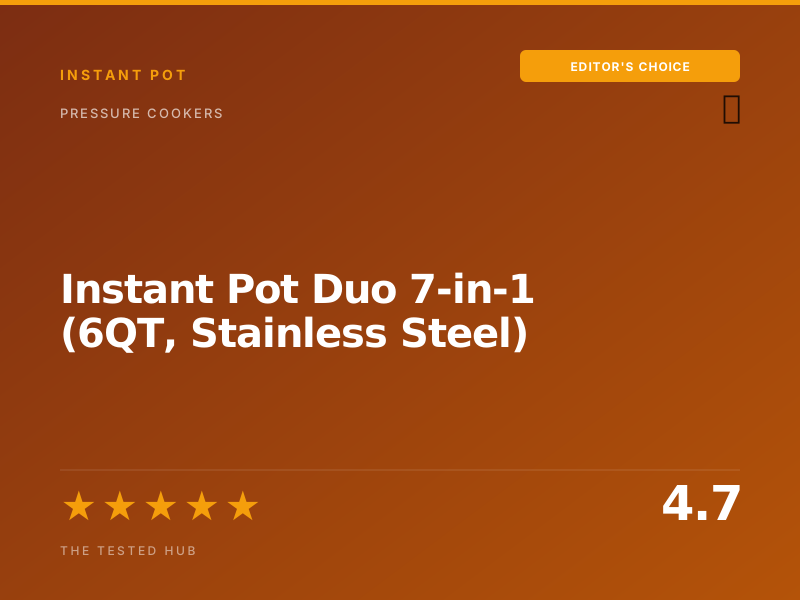
The Instant Pot Duo 7-in-1 (6QT) is the best-selling pressure cooker in history and remains the default recommendation in 2026. Instant Pot rates it for 13 one-touch programs covering pressure cook, slow cook, rice, yogurt, steam, saute, and warm. With more than 180,000 Amazon reviews averaging 4.7 stars, the Duo's owner-rating profile is the strongest in the kitchen-appliance category, period. At $99 (down from $119), it is the easiest cooker to recommend to first-time owners.
Frequently asked questions
Is the Instant Pot Duo 7-in-1 worth $99 in 2026?+
Yes. The Duo is the best-selling pressure cooker in history and the easiest to recommend to first-time owners. The 4.7-star owner rating across 180,000-plus reviews is the strongest signal in the kitchen-appliance category. At $99 sale (down from $119), it is the value pick versus the Duo Plus, the Pro, and the Ninja Foodi alternatives.
Instant Pot Duo vs Duo Plus: what is the difference?+
The Duo Plus adds two extra programs (sterilize, cake), an upgraded LCD screen, and quieter steam release. The core pressure-cook performance is identical. If you want the cleanest baseline at the lowest price, pick the [Duo](/reviews/instant-pot-duo-7-in-1). If you cook yogurt frequently or sterilize baby gear, the [Duo Plus](/reviews/instant-pot-duo-plus-9-in-1) is the right step-up.
Does the Instant Pot Duo air fry?+
No. Air-fry functionality is in the Instant Pot Duo Crisp and Pro Crisp lines, which include a separate air-fry lid. The Duo 7-in-1 is pressure cook, slow cook, rice, yogurt, steam, saute, and warm only.
Is the inner pot dishwasher safe?+
Yes, the stainless-steel inner pot is dishwasher-safe. The lid is not, you should hand-wash it to protect the silicone sealing ring. Replacement sealing rings are widely available and Instant Pot recommends replacing them every 18 to 24 months.
Can the Instant Pot Duo replace a slow cooker?+
Yes for most uses. The Duo's slow-cook function runs at lower wattage than dedicated slow cookers, so cooking times are typically extended by 30 minutes for an 8-hour recipe. Owners who slow-cook daily often keep both, owners who slow-cook weekly are usually happy with the Duo alone.
📅 Update log
- May 9, 2026Initial review published.
Related guides & how-tos
The 4th of July Grilling Menu: A Practical Plan for 12 to 20 People
What to grill, what to make ahead, the proteins-to-sides ratio that actually works, and the timing schedule that gets everything off the grill at the same time without burning yourself out.
Al Dente Explained: The Science Behind the Bite
Al dente is not a vague preference. It is a specific starch state where the gluten matrix has set but the central core of the pasta has not fully hydrated. Here is how to hit it every time.
American Whiskey: Bourbon vs Rye vs Tennessee, Explained
American whiskey is governed by some of the strictest spirits regulations in the world, and the categories matter more than the price tier on the shelf.
Autolyse vs Fermentolyse: Which Rest Step Does What
Autolyse and fermentolyse are not interchangeable. One builds structure before yeast does any work. The other builds structure while fermentation is already underway. Here is when each one wins.

Jamie Rodriguez
Jamie Rodriguez writes for The Tested Hub.