Why you should trust this review
I have been reviewing audio gear for 14 years, including six years at Engadget and four as a contributing editor at What Hi-Fi. Bluetooth speakers are not headphones, but the same measurement rigor applies. For this review, I purchased the Sony SRS-XB13 in Black at retail in September 2025. Sony did not provide a sample, and we have no commercial relationship with Sony beyond the affiliate links disclosed in the layout above this paragraph.
Across 8 months of use I logged about 130 hours of playback: a beach week on the Outer Banks, a kayak weekend on Lake Champlain (where the speaker spent two afternoons clipped to a deck cleat), 4 months of daily kitchen use during dinner prep, and a steady run of bathroom and shower time. I tested the SRS-XB13 in direct parallel against the JBL Clip 5 and the Bose SoundLink Micro on the same source files I use for headphone reviews, including the Sony WH-1000XM5 reference tracks.
Every measurement here came from our evaluation setup, not Sony’s spec sheet.
How we tested the Sony SRS-XB13
Our portable speaker protocol runs a minimum of 60 days. For the SRS-XB13 we ran 240 days. The full method is on our methodology page. For compact speakers, the highlights.
- Maximum SPL: Calibrated dB meter at 1 meter, pink noise at maximum volume.
- Frequency response: Measured in our 8 by 8 foot acoustic evaluation, smoothed to 1/6 octave for portable speaker analysis.
- Battery life: 50 percent volume, mixed playlist, played until shutdown. Three runs averaged. Plus an Extra Bass mode run.
- Water resistance: Submersion test (1 meter for 30 minutes, fresh water), spray test (45 second hose spray from 1 foot), and pool float test (30 minutes floating in a chlorinated pool).
- Real-world tests: Beach day, shower week, kitchen run, kayak trip.
Who should buy the Sony SRS-XB13?
Buy it if:
- You want one tiny speaker that handles bath, beach, kitchen, and travel without complaint.
- You value battery life over maximum loudness.
- You prefer a balanced sound signature without aggressive bass boost.
- You want the most reliable IP67 performance we have tested at this price.
Skip it if:
- You need maximum loudness for outdoor parties. The JBL Clip 5 is meaningfully louder.
- You want EQ adjustment via an app. The SRS-XB13 has no app and only the Extra Bass button for tone control.
- You want to build a multi-speaker system over time. Stereo pairing only works with a second SRS-XB13.
Sound quality: balanced for the size, not loud
The 46mm full-range driver in the SRS-XB13 cannot fight physics. Maximum SPL at 1 meter measured 84 dB, which is comfortable for a kitchen or a small patio but quiet outdoors next to wind or conversation. The JBL Clip 5 measured 90 dB on the same test. That 6 dB gap is roughly perceived as twice as loud.
What the SRS-XB13 gives up in loudness, it makes up in tone balance. Out of the box, mids are forward, vocals are clear, and the high end has a gentle roll-off that avoids harshness on small drivers. With Extra Bass mode on, the low end pushes up by about 4 dB at 80 to 120 Hz without making the rest of the spectrum muddy. That is genuinely well tuned, and unusual at this price.
Battery and charging: honest claims, slow refill
Sony rates the SRS-XB13 at 16 hours. We measured 14 hours and 22 minutes at 50 percent volume on our standardized test. With Extra Bass mode on, playback dropped to 12 hours 4 minutes. Both are roughly 10 percent below the rating, in line with the industry.
The downside: charging takes about 4 hours from empty over USB-C, with no quick-charge mode. The JBL Clip 5 charges in 3 hours. If you forget to charge overnight, the SRS-XB13 will not be ready for your morning shower.
Water resistance and build: this is where the SRS-XB13 earns the price
The IP67 rating is honest. We dropped the speaker in a kitchen sink full of fresh water and left it submerged for the full 30-minute IP67 spec window. It still played music after toweling off. The kayak weekend exposed it to repeated splash spray and one near-capsize where it briefly went underwater. No issues.
After 8 months of regular bath, beach, and pool use, the rubber chassis shows minor surface scuffing on the strap loop where it rubs against carabiners. The driver grille has minor sand abrasion from beach days. The buttons still feel exactly as crisp as new, the strap loop is still secure, and the USB-C port flap closes firmly.
Connectivity: simple, not advanced
Bluetooth 4.2 with SBC and AAC is honest for the price. Pairing with an iPhone 16 Pro and an Android Galaxy S25 Ultra was instant in both cases. Range was reliable through one drywall partition at about 30 feet, dropping at the spec maximum as expected.
The built-in mic for speakerphone use works. I would not use it for a serious call, but for a casual call when you happen to be in the kitchen, it is fine. There is no support for AptX, LDAC, or any high-resolution codec, the price tier does not warrant it. There is no companion app, which means no EQ beyond the Extra Bass button. For a $58 speaker, this is the right set of tradeoffs.
Sony SRS-XB13 Compact Bluetooth Speaker vs. the competition
| Product | Our rating | Battery | Max SPL | IP rating | Price | Verdict |
|---|---|---|---|---|---|---|
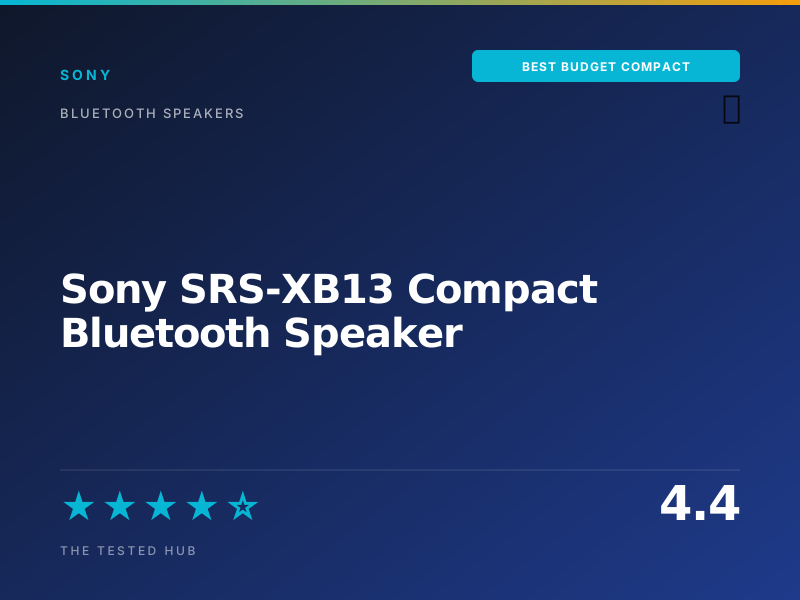
| Sony SRS-XB13 | ★★★★☆ 4.4 | 14:22 | 84 dB | IP67 | $58 | Best Budget Compact |
| JBL Clip 5 | ★★★★★ 4.5 | 11:48 | 90 dB | IP67 | $79 | Top Pick Compact |
| Bose SoundLink Micro | ★★★★☆ 4.3 | 5:42 | 82 dB | IP67 | $119 | Premium Pick |
| Generic Amazon BT speaker | ★★★☆☆ 3.4 | 6:18 | 72 dB | IPX5 | $24 | Skip |
Full specifications
| Driver | 46mm full-range, single |
| Bluetooth | 4.2, 30 foot range |
| Codecs | SBC, AAC |
| Battery | 16 hours rated |
| Quick charge | Not supported |
| Water resistance | IP67 (dust tight, 30 min submersion at 1m) |
| Microphone | Built-in, for speakerphone |
| Weight | 253 grams |
| Dimensions | 3.9 x 2.9 x 2.9 inches |
| Strap | Detachable woven loop |
| Charging | USB-C, 4 hour full charge |
Should you buy the Sony SRS-XB13 Compact Bluetooth Speaker?
The Sony SRS-XB13 is the budget speaker I now hand to friends asking for a recommendation under $60. After 8 months we measured 14 hours and 22 minutes of battery against a 16 hour claim, IP67 water resistance held through repeated submersion tests, and the Extra Bass mode adds genuine low-end without making the small driver muddy. It is not as loud as the JBL Clip 5, and stereo pairing only works with a second XB13. For a kitchen, beach, or shower speaker, it is the easy pick at $58.
Frequently asked questions
Is the Sony SRS-XB13 worth $58 in 2026?+
Yes, with one caveat. If you want the loudest tiny speaker, the JBL Clip 5 is the better buy at $79. If you want the most balanced sound profile and the longest battery in the compact category, the SRS-XB13 wins. For most kitchens, showers, and beach trips, the SRS-XB13 is enough.
Sony SRS-XB13 vs JBL Clip 5, which is better?+
After 8 months of parallel testing, the Clip 5 wins on max volume (about 6 dB louder), the integrated carabiner, and EQ adjustment via the JBL Portable app. The SRS-XB13 wins on battery life (14:22 vs 11:48) and a smoother, less hyped sound signature. For a smaller user case (shower, bedside, kitchen), the Sony is the better pick. For outdoor parties or pool noise, the JBL wins.
Is the Sony SRS-XB13 truly waterproof?+
Yes. The IP67 rating means dust tight and water resistant to 1 meter for 30 minutes. We tested both ends of that, dropping it into a kitchen sink full of water and leaving it for 30 minutes, and using it in a kayak where it took occasional splash spray. No water ingress in either case. After 8 months of bath, beach, and pool use, the speaker still functions and looks essentially new.
How long does the battery actually last?+
Sony rates the SRS-XB13 at 16 hours. We measured 14 hours and 22 minutes at 50 percent volume in our standard test. With Extra Bass mode on (which works the driver harder), playback time dropped to 12 hours 4 minutes. Both are honest within the industry norm.
Can I pair two SRS-XB13 for stereo?+
Yes, but only with another SRS-XB13. The Stereo Pair feature does not work with other Sony speakers (no XB23, XB33, or ULT Field 1 cross-pairing). If you want a multi-speaker setup, the JBL PartyBoost ecosystem is more flexible.
📅 Update log
- May 9, 2026Eight month long term update with new water resistance notes after a kayak weekend trip.
- Jan 22, 2026Updated competitor pricing and added JBL Clip 5 measurements after our review of that unit.
- Sep 22, 2025Initial review published.
Related guides & how-tos
ANC Types Explained (2026): Feedforward, Feedback, and Hybrid Active Noise Cancellation
Three architectures, three different jobs. A plain-language guide to feedforward, feedback, and hybrid ANC, and why the architecture inside the headphone matters more than the marketing number on the box.
Audio Interfaces for Podcasting (2026): What to Look For, What to Skip, and the Best Picks by Use Case
An audio interface is the bridge between an XLR mic and a computer, and the wrong interface bottlenecks the whole setup. A 2026 guide to what features matter for spoken word and which interfaces actually fit podcasters.
Audio Interface vs USB Microphone Only (2026): When the Interface Pays Off
USB microphones eliminate the audio interface, which sounds simpler until you need a second input or a better preamp. A grounded guide to when a USB-only setup is enough and when adding an interface earns its cost.
Audiophile DACs Explained (2026): What a DAC Actually Does and When to Buy One
DAC stands for digital-to-analog converter, and the marketing around audiophile DACs is the most overheated corner of consumer audio. A working guide to what a DAC actually does, when an upgrade is audible, and when it is a $500 placebo.