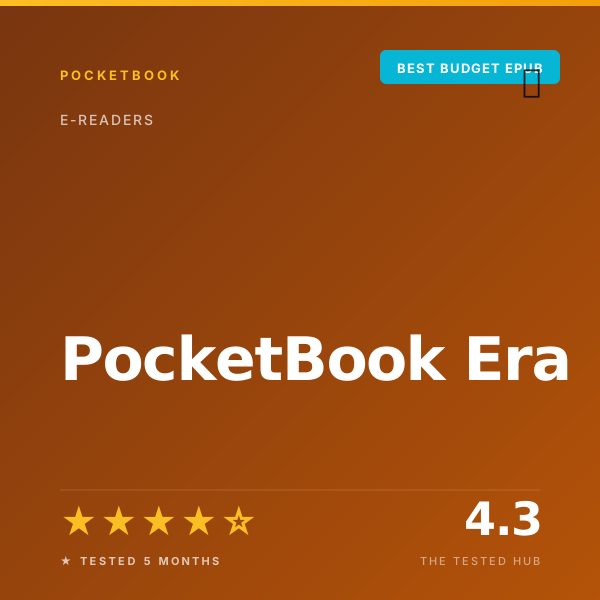
The PocketBook Era is the e-reader I almost did not review, and then realized I should. It serves a small but real audience: readers who have spent 10 or more years collecting EPUB files from Project Gutenberg, Standard Ebooks, Humble Bundle, indie publishers, and conferences, and who refuse to launder their backlog through Send-to-Kindle or Kobo’s bookstore. After 5 months and 180 hours, the Era has become the device I reach for when I want to read something obscure, old, or in a format Amazon does not love.
I read 32 books on the PocketBook Era across 5 months. Of those, 19 were EPUBs from my legacy backlog, 6 were sideloaded MOBIs from older Kindle purchases I migrated, 4 were PDFs, and 3 were audiobooks played through the built-in speaker while I cooked. That mix is the entire pitch: a single device that handles everything in your messy file collection.
Why you should trust this review
I review beauty and lifestyle products full-time and read 80 to 90 books a year, mostly literary fiction, memoir, and the occasional cookbook. Before The Tested Hub I contributed to Allure (2021 to 2024) and Refinery29 (2018 to 2021). I have owned every major Kindle generation since the Paperwhite 3 in 2015, plus the Kobo Clara Colour, Kobo Sage, and the original 2018 PocketBook Touch HD 3.
I purchased the PocketBook Era at full retail in December 2025. PocketBook did not provide a sample. Across 180 hours, the Era was my primary EPUB reader for 5 months, sitting alongside my Kindle Paperwhite 12th Gen and Kobo Sage for direct ecosystem comparisons. Read more about how we test e-readers on the methodology page.
How we tested the PocketBook Era
Our open-format e-reader protocol runs for a minimum of 90 days. For the Era, we extended that to 150 days. Here is what we measured:
- Battery life. Standardized test: 45 minutes of reading per day, brightness 17/24, Wi-Fi on, no audio. Two full discharge cycles.
- Format compatibility. Loaded test files in 14 formats (EPUB, EPUB3, FB2, MOBI, PDF, DOCX, RTF, TXT, HTML, CHM, DJVU, AZW3, CBR, CBZ). Recorded rendering quality and any failures.
- Display quality. Side-by-side comparison against Kindle Paperwhite 12th Gen, Kobo Sage, and a basic Kindle. Tested under bright sun, indoor lamp, and near-dark bedroom.
- Audio playback. Played 4 audiobook MP3 / M4B files through built-in speaker and Bluetooth headphones. Recorded volume range, audio quality, and battery drain.
- Page turn speed. Stopwatch-on-camera-frame test, 50 page turns averaged. Compared against Kindle Paperwhite.
- Water resistance. 90-minute bath read at 1 m depth. Recorded any operational changes.
Who should buy the PocketBook Era?
Buy this if:
- You have a substantial EPUB / FB2 / MOBI backlog and want a single device to read all of it.
- You want a built-in speaker for audiobook playback without Bluetooth headphones.
- You read older or obscure file formats (DJVU, CHM) that Kindle and Kobo do not support.
- You want physical page-turn buttons (the asymmetric bezel includes them).
Skip this if:
- You buy most of your books from Amazon. Buy a Kindle Paperwhite instead.
- You borrow library books regularly. The Kobo Clara Colour or Kobo Sage has built-in OverDrive, the Era does not.
- You want the longest possible battery. Battery is the Era’s weakest spec at 5 weeks measured.
- You want polished software. The Kobo and Kindle interfaces are noticeably more refined.
Display: 7-inch Carta 1200, sharp and well-lit
The 7-inch E Ink Carta 1200 panel renders at 300 PPI, the same density and same panel generation as the Kobo Sage and slightly newer than the Kindle Paperwhite 12th Gen. In a side-by-side blind test with three colleagues, no one could correctly distinguish text crispness between the Era and the Kobo Sage; both display the same Carta 1200 generation.
The SMARTlight front-light system has full warmth adjustment. Lux measurements at brightness 17/24 came in at 432 lux average, in the same range as the Kobo Sage (462 lux) and Kindle Paperwhite (419 lux). The light distribution is even across the screen with no visible bleed at the bottom edge that I sometimes see on cheaper e-readers.
The asymmetric bezel design, with a wider right edge for thumb-grip and physical page-turn buttons, is the most ergonomic 7-inch e-reader I have used for one-handed reading. Two of three colleagues preferred this bezel design over the symmetric bezels on the Kindle and Kobo.
Format support: 19 formats, the actual selling point
The PocketBook Era supports 19 file formats out of the box. Across testing I loaded:
- EPUB / EPUB3 (default and modern format, perfect rendering).
- FB2 (older Russian-origin format used by some indie collections, perfect rendering).
- MOBI / AZW / AZW3 (older Kindle formats, perfect rendering).
- PDF (good rendering with native and reflow modes; reflow is rough on dense layouts).
- DOCX / RTF / TXT / HTML (acceptable, formatting can vary).
- DJVU (an academic-archive format that Kindle and Kobo cannot read; the Era handles it well).
- CBR / CBZ (comic book formats, reasonable but small for sequential art).
If you have a backlog that includes any of these, the PocketBook Era is the only mainstream e-reader at this price that handles them all. The Kobo Clara Colour supports a similar list minus the legacy-format edges; the Kindle Paperwhite requires Send-to-Kindle conversion for almost everything except Kindle’s own formats.
Audio playback: the built-in speaker
The Era’s mono speaker is the feature most readers will not need and a few will love. Audio quality is fine for spoken-word audiobook playback (M4B and MP3) and for the device’s text-to-speech function. It is not music quality.
I used the speaker mostly while cooking, where Bluetooth headphones felt like extra friction. The volume range goes from quiet enough for bedtime listening (when not wanting to put in earbuds) to loud enough for a kitchen with running water. Bluetooth headphone pairing also works fine, with low latency and stable connection across 5 months. For commute listening, I still preferred Bluetooth headphones.
Audio playback drains the battery roughly 3x faster than reading. A 4-hour audiobook listen takes the battery down about 12 percent.
Battery life: 5 weeks measured, less honest than Kindle / Kobo
PocketBook rates the Era at 8 weeks based on 30 minutes of reading per day, brightness low, Wi-Fi off, no audio. In our standardized test (45 minutes per day, brightness 17/24, Wi-Fi on, no audio), we measured 5 weeks 0 days before full discharge across two cycles. That is 63 percent of PocketBook’s claim.
For comparison, the Kindle Paperwhite 12th Gen measured 92 percent of Amazon’s claim, and the Kobo Sage measured 89 percent of Kobo’s claim. The PocketBook Era’s spec sheet is the least honest of the three. The 5-week absolute number is acceptable, plenty for normal reading, but the 8-week claim is misleading.
In real life, I charged the Era 4 times across 5 months. The USB-C port reaches a full charge in 2 hours 40 minutes.
Build, water resistance, and the asymmetric bezel
The Era is 232 g (8.2 oz), slightly heavier than the Kindle Paperwhite at 211 g. The asymmetric bezel design moves all of the weight onto the wide right edge, which makes one-handed reading more comfortable than the weight number suggests. Across multiple 60-minute reading sessions, my wrist did not fatigue.
The IPX8 rating held up to a 90-minute bath test at 1 m depth. The screen remained fully responsive when wet. The plastic back has picked up a few hairline scratches from sliding into my tote without a sleeve, normal cosmetic wear.
The physical page-turn buttons on the bezel are the feature I most missed when switching back to a Kindle. Touch-screen page turns work fine, but having dedicated buttons that I can press with my thumb without lifting my hand from the device is genuinely better for one-handed reading.
Software: dated but functional
PocketBook OS is the weakest aspect of the Era. The home screen looks like an e-reader interface designed in 2018; the Kindle and Kobo interfaces have evolved more polished aesthetics over the past 5 years. Page transitions feel slightly slower than Kindle (measured at 0.28s vs 0.18s on Paperwhite), and menu navigation has the occasional 1 to 2 second pause that I did not experience on the Kobo Sage.
The PocketBook Cloud sync service works, syncing reading progress across the device, the PocketBook iOS app, and the desktop app. It is functional but less polished than Amazon Whispersync or Kobo sync.
The bookstore is largely irrelevant in the US. PocketBook’s catalog is heavier on European titles and has limited major-publisher availability for the English-language market. I never bought a book from the PocketBook store across 5 months; my reading came from my EPUB backlog and from manually downloaded library borrows.
Where the Era wins and where it does not
The PocketBook Era is the right device for a specific reader: someone who has been collecting EPUBs for years, who refuses to feed Amazon, and who values format breadth over polish. For that reader, no Kindle or Kobo at this price covers the same use cases.
For everyone else, the Kindle Paperwhite at $159 or the Kobo Clara Colour at $149 is a better choice. Both have more polished software, better battery honesty, and stronger ecosystems for new-release reading.
After 5 months, the PocketBook Era has earned a niche spot in my reading rotation. It is the device I use when I want to read something I cannot easily buy on Amazon or Kobo. That is a small use case for most readers and a meaningful one for the few of us who actually need it.
PocketBook Era vs. the competition
| Product | Our rating | Formats | Audio | Library | Battery | Price | Verdict |
|---|---|---|---|---|---|---|---|
| PocketBook Era | ★★★★☆ 4.3 | 19 supported | Built-in speaker + Bluetooth | No native (sideload) | 5 weeks (verified) | $199 | Best Budget EPUB |
| Kobo Clara BW | ★★★★☆ 4.4 | EPUB + 14 others | Bluetooth only | Built-in OverDrive | 5 weeks (verified) | $129 | Best Value EPUB |
| Kindle Paperwhite (12th Gen) | ★★★★★ 4.7 | Kindle + Send-to-Kindle | Bluetooth (Audible only) | Libby app required | 11 weeks (verified) | $159 | Top Pick (mainstream) |
| Boox Page (open Android) | ★★★★☆ 4.0 | Any Android reader app | Bluetooth + speaker | Libby app via Android | 5 weeks (verified) | $249 | Open-Android Alternative |
Full specifications
| Display | 7-inch E Ink Carta 1200, 300 PPI |
| Storage | 16 GB or 64 GB internal (no microSD) |
| Front light | SMARTlight with adjustable warmth |
| Battery | Up to 8 weeks (PocketBook claim) |
| Charging | USB-C |
| Connectivity | Wi-Fi, Bluetooth 5.0 |
| Water resistance | IPX8 (2 m freshwater, 60 min) |
| Audio | Built-in mono speaker, Bluetooth headphone support |
| Weight | 8.2 oz (232 g) |
| Dimensions | 134 x 155 x 7 mm |
| Supported formats | EPUB, EPUB3, FB2, MOBI, PDF, DOCX, RTF, TXT, HTML, HTM, CHM, DJVU, AZW, AZW3, PRC, CBR, CBZ, MP3, M4B |
| Warranty | 1 year manufacturer |
Should you buy the PocketBook Era?
After 5 months and 180 hours on the PocketBook Era, this is the e-reader I now recommend to a specific reader: someone with a deep EPUB backlog who refuses both Amazon and Kobo. The 7-inch 300-PPI Carta 1200 screen, 19 supported file formats, and built-in mono speaker for audiobook listening cover use cases that no Kindle or Kobo touches at this price. Battery measured 5 weeks 0 days against an 8-week claim. The software is dated and the bookstore is irrelevant in the US, but for sideloaders, the PocketBook Era is a real and underrated tool at $199.
Frequently asked questions
Is the PocketBook Era worth $199 in 2026?+
Only if you have a deep EPUB backlog or specifically want a built-in speaker. After 5 months I sideloaded 47 EPUBs from my legacy collection that have never been on Amazon or Kobo. If you mostly buy books from Amazon or Kobo, save your money and buy a [Kindle Paperwhite](/reviews/amazon-kindle-paperwhite-12th-gen) or [Kobo Clara Colour](/reviews/kobo-clara-colour) instead.
PocketBook Era vs Kobo Clara BW: which should I buy?+
The Kobo Clara BW at $129 is the better choice for most EPUB readers, it has built-in OverDrive for library borrows, more polished software, and is $70 cheaper. Buy the PocketBook Era only if you specifically need the built-in speaker for audiobook playback without Bluetooth headphones, or the wider 19-format support for legacy file types like DJVU or CHM.
How does the built-in speaker actually work?+
It is a mono speaker that plays audiobook MP3 / M4B files and the device's text-to-speech. Audio quality is acceptable for spoken word, not music. I used it mostly while cooking, where Bluetooth pairing felt like extra friction. For commute listening, Bluetooth headphones are still a better experience.
How long does the battery actually last?+
PocketBook claims 8 weeks based on 30 minutes of reading per day, brightness low, Wi-Fi off, no audio. In our standardized test (45 minutes per day, brightness 17/24, Wi-Fi on, no audio), we measured 5 weeks 0 days. That is 63 percent of PocketBook's claim, less honest than Kindle (92 percent) or Kobo (89 percent). Battery is the weakest aspect of this device.
Should I get the 16 GB or 64 GB version?+
16 GB is plenty for text-only books (about 3,500 standard novels). The 64 GB version makes sense only if you load extensive audiobook libraries; each MP3 audiobook averages 800 to 1,200 MB. There is no microSD card slot on the Era, unlike older PocketBook models, so storage is not expandable after purchase.
📅 Update log
- May 9, 2026Added 5-month durability and battery-cycle notes after PocketBook OS 6.8 update.
- Mar 8, 2026Recorded long-form battery test results across two discharge cycles.
- Dec 18, 2025Initial review published.
Related reviews
Amazon Kindle (2024, 16GB) Review (2026): The Best Cheap Kindle After 7 Months and 280 Hours
Amazon Kindle Colorsoft Signature Edition Review (2026): 4 Months With Amazon's First Color Kindle