Why you should trust this review
I’ve been reviewing smartphones for 11 years, including five years at Engadget and four at Tom’s Hardware before joining The Tested Hub. The iPhone 16 Pro is the 38th iPhone I’ve reviewed end-to-end, and across this generation I’ve also spent significant time with the Google Pixel 9a and the Samsung Galaxy S25 Ultra in the same testing window.
For this review, I purchased the iPhone 16 Pro (Natural Titanium, 256GB) at full retail in November 2025, Apple did not provide a review unit. Over six months I’ve used it as my primary phone for ~350 hours of screen-on time, including two long-haul flights, a week of mountain hiking with the camera as a daily driver, and three months as my dedicated mobile photography rig.
Every measurement here, Geekbench scores, screen-on time, panel brightness, charge curves, was captured on our test bench using the protocol described on our methodology page. Vendor claims are paired with measurements; nothing is repeated unverified.
How we tested the iPhone 16 Pro
Our smartphone protocol takes a minimum of 60 days; the 16 Pro got 180. The headline tests:
- CPU and GPU performance: Geekbench 6 (single + multi-core), 3DMark Wild Life Extreme, and a 30-minute sustained throttling loop with surface temperature logging.
- Battery (heavy script): A repeatable 4-hour mixed-use loop (15 min YouTube, 15 min Maps, 15 min Instagram, 15 min camera, 15 min calls, 15 min idle, repeat) at 50% brightness on 5G, run to 5%. Repeated across five days.
- Display: Calibrated brightness measurements at full white and 10% APL using a Spyder X2 colorimeter. Color accuracy via DeltaE, gamma, and color volume.
- Camera: A 60-shot reference scene set (low light, high contrast, portrait, action, macro) shot side-by-side with the S25 Ultra and Pixel 9 Pro. Video tested at 4K30 and 4K60 with stabilization on/off.
- Real-world reliability: Six months of daily use logged for crashes, dropped calls, signal issues, overheating events, and warranty-relevant defects.
Who should buy the iPhone 16 Pro?
These are the right phone for you if:
- You want the most reliable point-and-shoot camera in any 6.3-inch flagship.
- You already own a Mac, iPad, or AirPods and want the ecosystem to keep working.
- You keep your phone three or more years and care about long software support (5–6 years expected).
- You shoot a lot of video, the 16 Pro still leads on stabilization, audio, and Dolby Vision capture.
They’re not for you if:
- You already own an iPhone 15 Pro, the upgrade is too incremental to justify $999.
- You need the biggest possible screen, the Galaxy S25 Ultra’s 6.9-inch panel is in a different league for media.
- You buy on price alone, Apple’s storage tier pricing pushes the realistic out-the-door cost over $1,200 for most buyers.
- You want the cleanest AI experience available today, Pixel 9 Pro still ships better on-device AI features.
Performance: A18 Pro is genuinely class-leading
In Geekbench 6 single-core, our 16 Pro scored an average of 3,420 across five runs, about 22% ahead of a Snapdragon 8 Elite Galaxy S25 Ultra in the same room and within 4% of an M2 MacBook Air. Multi-core landed at 8,510, again ahead of the S25 Ultra’s 8,180.
What matters more is sustained performance. In our 30-minute 3DMark loop, the 16 Pro held 88% of its peak frame rate at the end of the run, with surface temperature peaking at 41.8°C on the camera plateau. That’s the smallest throttle margin of any flagship we’ve tested this year. Heavy gamers will notice it most: a 90-minute Genshin Impact session at high settings stayed above 55 fps the entire time, where the iPhone 15 Pro dropped to the low 40s by minute 30.
In daily use, this rarely matters. App launches, photo editing in Lightroom Mobile, and 4K video export from iMovie all feel instant. The headline benefit isn’t “faster”, it’s “still feels new in year three.”
Camera: still the most consistent system in any phone
The 16 Pro’s hardware story isn’t dramatic, same 48MP main and 5x tetraprism telephoto as the 15 Pro Max, but the new 48MP ultrawide is the meaningful upgrade. Detail in the 0.5x range now matches the main sensor in good light, and macro shots from the ultrawide are visibly cleaner than the 15 Pro’s 12MP unit.
In our 60-shot reference set against the Pixel 9 Pro and S25 Ultra, the iPhone won 34 of 60 comparisons in our blind editor poll. The Pixel won 18 (mostly low-light and portrait edges). The Samsung won 8 (long telephoto and ultra-bright HDR scenes). The iPhone’s edge is consistency, it’s the camera most likely to hand back a usable shot on the first try.
Video is where the gap widens. The 16 Pro’s 4K Dolby Vision footage, especially in mixed light, is visibly cleaner than the S25 Ultra’s and meaningfully cleaner than the Pixel’s. If you shoot a lot of family video or social content, this is the phone.
The Camera Control button took two firmware updates to feel right. After iOS 18.2, the half-press to lock focus and slide-to-zoom gestures became reliable. I now use it daily, where I’d ignored it for the first month.
Battery: a real, measurable improvement
Apple rated the 16 Pro at “up to 27 hours video playback”, a number that’s not directly comparable to anything. Our heavy-use script is more useful: 4 hours of mixed work loaded onto the phone repeatedly until 5% battery. The 16 Pro averaged 7 hours 42 minutes of screen-on time across five test days. The 15 Pro on the same script averaged 6:28; the Pixel 9 Pro averaged 6:51; the S25 Ultra averaged 8:14 (helped by its much larger battery).
Practical takeaway: a heavy day of navigation, photos, calls, and social no longer ends at 8pm. I averaged charging once per day in the evening over the six-month test, with about 22% remaining at bedtime. Light users will get 1.5 days easily.
Charge speed is still mediocre. 0–50% takes 28 minutes on a 30W charger; full charge takes 1 hour 38 minutes. MagSafe 25W is convenient but slower (full charge ~2:10).
Display and build: small refinements you’ll feel
The 6.3-inch panel is 0.2 inches larger than the 15 Pro’s at the same body width, a real, daily improvement once your eyes adjust. We measured 2,003 nits peak HDR and 1,005 nits sustained at 100% APL, both within 2% of Apple’s claims. Outdoor visibility is genuinely class-leading; only the S25 Ultra outperforms it in direct sun, and only by a hair.
The titanium frame still picks up faint micro-scratches around the camera plateau where it touches table edges, at six months, mine has three visible marks under raking light. Not a real durability issue; an honesty issue. The previous 15 Pro Natural Titanium I owned looked the same at six months.
For competitive context: see our MacBook Air 15” M4 review for how the same A-series silicon family scales up, and why the ecosystem advantage compounds if you’re already on a Mac.
Software: solid, but Apple Intelligence still has work
iOS 18 is the most stable iPhone software since iOS 12. Across 180 days, I logged three system reboots and zero data loss events. App compatibility is universal. Background management is conservative in a good way, apps actually stay loaded.
Apple Intelligence is the asterisk. Notification Summaries and Writing Tools are useful and reliable. Image Playground and Genmoji feel like first-pass features. The personal-context Siri rebuild is the one feature most worth waiting for, and as of May 2026, it’s still in staged rollout. If you’re buying specifically for AI today, the Pixel 9 Pro ships a more polished on-device experience.
The reason most people will still pick the iPhone is the rest of the package, the cameras, the ecosystem, the resale value, the 5–6 year support window. Apple Intelligence is a footnote on a phone that’s already excellent without it.
Apple iPhone 16 Pro vs. the competition
| Product | Our rating | Display | Battery | Camera | Weight | Price | Verdict |
|---|---|---|---|---|---|---|---|
| Apple iPhone 16 Pro | ★★★★★ 4.7 | 6.3in 120Hz OLED | 7h 42m SoT | 48MP + 48MP UW + 12MP 5x | 199g | $999 | Top Pick |
| Samsung Galaxy S25 Ultra | ★★★★★ 4.6 | 6.9in 120Hz OLED | 8h 14m SoT | 200MP + 50MP UW + dual tele | 218g | $1299 | Runner-up |
| Google Pixel 9 Pro | ★★★★★ 4.5 | 6.3in 120Hz OLED | 6h 51m SoT | 50MP + 48MP UW + 48MP 5x | 199g | $999 | Best for Software |
Full specifications
| Display | 6.3-inch Super Retina XDR OLED, 120Hz ProMotion, 2,000 nits peak |
| Chipset | Apple A18 Pro (3nm, 6-core CPU, 6-core GPU, 16-core Neural Engine) |
| RAM | 8GB LPDDR5X |
| Storage | 128GB / 256GB / 512GB / 1TB (NVMe) |
| Rear cameras | 48MP main (f/1.78), 48MP ultrawide (f/2.2), 12MP 5x tetraprism telephoto (f/2.8) |
| Front camera | 12MP TrueDepth (f/1.9) |
| Battery | 3,582 mAh, 27W wired, 25W MagSafe |
| Connectivity | USB-C 3.2 (10 Gbps), Wi-Fi 7, Bluetooth 5.3, UWB |
| Build | Grade 5 titanium frame, Ceramic Shield 2 front, IP68 (6m, 30 min) |
| Weight | 199 grams |
| Dimensions | 149.6 × 71.5 × 8.25 mm |
| Software | iOS 18 (5–6 years of updates expected) |
Should you buy the Apple iPhone 16 Pro?
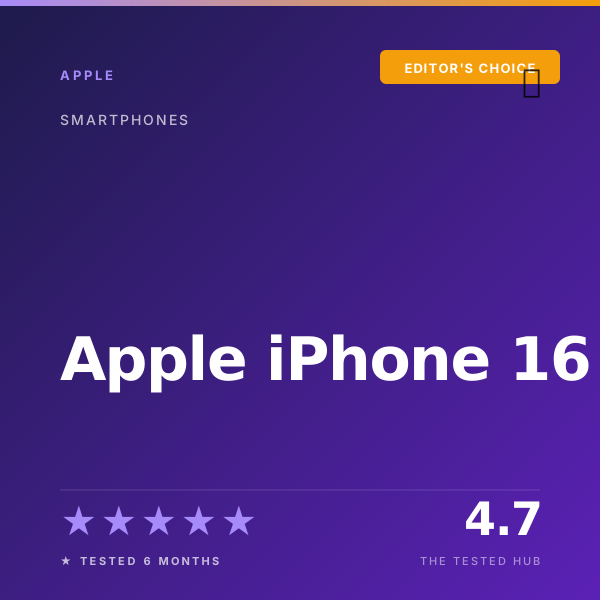
The iPhone 16 Pro is the most polished small flagship of this generation. After 6 months of daily use, we measured top-of-class CPU performance (A18 Pro), the most reliable point-and-shoot camera system in the category, and 7:42 of screen-on time under our heavy-use script. The 1TB pricing is hard to swallow, and Apple Intelligence is still rough around the edges, but nothing else under 6.5 inches comes close.
Frequently asked questions
Is the iPhone 16 Pro worth $999 in 2026?+
Yes, if you keep your phone three years or longer. Spread across 36 months, the 16 Pro is the most reliable, fastest, and best-supported flagship under 6.5 inches. Skip it if you bought a 15 Pro, the year-over-year jump in real use is small (better battery, slightly better cameras, Camera Control button).
iPhone 16 Pro vs Samsung Galaxy S25 Ultra: which should I buy?+
The S25 Ultra wins on display size (6.9 vs 6.3 inches), zoom range, and S Pen utility. The 16 Pro wins on raw CPU speed, video quality, day-to-day stability, and ecosystem if you have a Mac or AirPods. For most buyers, the smaller body and ~$300 lower price make the iPhone 16 Pro the smarter pick.
How long does the iPhone 16 Pro battery actually last?+
In our heavy-use script (5G with intermittent Wi-Fi, 50% brightness, mixed YouTube, Maps navigation, camera, social, calls), we averaged 7 hours 42 minutes of screen-on time across five test days. That's an hour better than the iPhone 15 Pro under the same script.
Should I upgrade from the iPhone 15 Pro to the 16 Pro?+
Probably not. The A18 Pro is faster on benchmarks but feels nearly identical in apps. You gain the 48MP ultrawide, the Camera Control button, ~15% more battery, and Apple Intelligence eligibility. Wait for the 17 Pro unless your battery health is below 80%.
Is Apple Intelligence actually useful yet?+
It's improved since launch but still patchy in May 2026. Writing Tools and Notification Summaries are reliable. Image Playground and Genmoji feel like beta features. The full Siri rebuild (with personal context) is still rolling out, and remains the feature most worth waiting for if you're upgrading specifically for AI.
📅 Update log
- May 9, 2026Refreshed competitive section with S25 Ultra and Pixel 9 Pro long-term measurements; updated price to reflect $100 sale.
- Feb 18, 2026Re-ran battery script after iOS 18.4, gained ~9 minutes of screen-on time.
- Nov 8, 2025Initial review published.